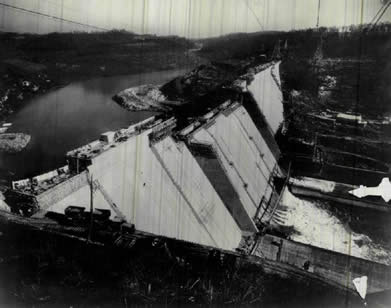
 Norris Dam is a hydroelectric and flood control
structure located on the Clinch River in Anderson County and
Campbell County, Tennessee, USA. Its construction in the mid-1930s
was the first major project for the Tennessee Valley Authority,
which had been created in 1933 to bring economic development
to the region and control the rampant flooding that had long
plagued the Tennessee Valley. The dam was named in honor of Nebraska
Senator George Norris (1861-1944), a longtime supporter of government-owned
power in general, and supporter of TVA in particular.
Norris Dam is a hydroelectric and flood control
structure located on the Clinch River in Anderson County and
Campbell County, Tennessee, USA. Its construction in the mid-1930s
was the first major project for the Tennessee Valley Authority,
which had been created in 1933 to bring economic development
to the region and control the rampant flooding that had long
plagued the Tennessee Valley. The dam was named in honor of Nebraska
Senator George Norris (1861-1944), a longtime supporter of government-owned
power in general, and supporter of TVA in particular.
Norris Dam is a straight concrete
gravity-type dam. The dam is 1860 feet (570 m) long and 265
feet (81 m) high.
Norris Lake, the largest reservoir on a tributary of the Tennessee
River, has 33,840 acres (137 km²) of water surface and 809
miles (1302 km) of shoreline. The dam has a maximum generating
capacity of 131,400 kilowatts.
Location
The Clinch River flows southwestward
for 300 miles (480 km) from its headwaters in Virginia through
the rugged,
sparsely-populated hills of northeastern Tennessee before emptying
into the Tennessee River near Kingston. Norris Dam is located
at just over 79 miles (127 km) upstream from the mouth of the
Clinch, immediately downstream from the river’s confluence
with Cove Creek, which joins the river from the northwest. The
reservoir includes parts of Anderson, Campbell, Union, Claiborne,
and Grainger counties. Norris Reservoir spans a 73-mile (117
km) stretch of the Clinch from the dam to River Ridge at the
Claiborne-Grainger county line. The reservoir also covers the
lower 56 miles (90 km) of the Powell River, which empties into
the Clinch 10 miles (16 km) upstream from Norris Dam. The dam’s
tailwaters are part of Melton Hill Lake, which stretches for
56 miles (90 km) along the Clinch from Norris to Melton Hill
Dam.
Norris Freeway, a section of U.S. Highway 441 widened
in the 1930s to aide in dam construction, crosses the top of
Norris Dam and connects the area to Interstate 75 at Caryville
to the west and Knoxville to the south. Along with the reservation
maintained by TVA for the operation of Norris Dam, most of the
lower Norris Reservoir is surrounded by conservation lands, including
Norris Dam State Park adjacent to the reservation, the Cove Creek
Wildlife Management Area across the lake to the north, and the
Chuck Swan State Forest, which protects a large undeveloped area
a few miles upstream.
 Background and Construction
As early as 1911, the present site
of Norris Dam— initially
called the “Cove Creek site”— was identified
as a prime location for a sizeable dam. Several government and
private entities believed that a dam in the upper Tennessee Valley,
working in conjunction with dams at Muscle Shoals, Alabama, could
provide badly needed flood control to East Tennessee and help
keep the Tennessee River consistently navigable year-round. In
the early 1920s, several entities— including the Tennessee
Electric Power Company (TEPCo), the Knoxville Power & Light
Company, and Union Carbide— applied for permits to build
a dam at the Cove Creek site, although all were eventually withdrawn
or rejected. Part of the opposition was from Senator Norris,
who advocated a government-sponsored dam at the site, arguing
that a private entity would be almost wholly concerned with power
generation rather than flood control and coordination with projects
elsewhere in the valley. Norris proposed constructing a network
of dams throughout the valley to help regulate its outflow into
the lower Mississippi River. Throughout the late 1920s, the U.S.
Army Corps of Engineers made several proposals to build a dam
at the site, but all were rejected by Congress or vetoed by President
Calvin Coolidge.
The Tennessee Valley Authority was
formed in 1933 as part of President Franklin D. Roosevelt’s New Deal legislation.
The act authorizing TVA’s establishment (signed on May
18, 1933) authorized TVA to immediately begin construction on
a dam at the Cove Creek site. On July 30, TVA renamed the Cove
Creek project for Senator Norris and began preparations for the
dam’s construction. As the agency lacked any engineering
or dam construction experience, it relied heavily on the Army
Corps’ original design, and received ample consulting from
the U.S. Bureau of Reclamation. Hungarian-American architect
Roland Wank (1898-1970) revised the initial plans from Bureau
of Reclamation engineers, and gave the poured-concrete Norris
Dam a modernist style, which was controversial and advanced for
the era of construction, but the result would eventually succeed
in elevating Roland Wank to the position of Chief Architect for
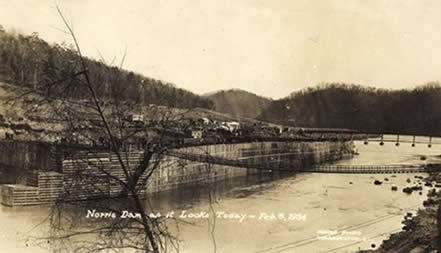
TVA from 1933 through 1944. Construction began on October 1,
1933.
The building of Norris Dam and its
accompanying reservoir required the purchase of over 152,000
acres (62,000
ha) of land. 2,841 families and 5,226 graves were relocated.
The community of Loyston, located about 20 miles (32 km) upstream
from the dam site, was entirely inundated. Approximately one-third
of Caryville, at the head of the reservoir’s Cove Creek
embayment, was flooded and a number of structures in the town
had to be moved. Several smaller 30-foot (9.1 m) earthen dams
were built along reservoir tributaries to house fish hatcheries.
As the project called for the construction of recreational areas
along the lakeshore, TVA built two supplemental dams— Caryville
Dam and Big Ridge Dam— to impound Cove Lake and Big Ridge
Lake, respectively, and ensure these small lakes would remain
filled year-round. The Civilian Conservation Corps built recreational
facilities and aided in the removal of various structures. The
town of Norris, Tennessee was initially built as a planned community
to house the workers involved in the construction of this dam.
Norris Dam was completed and the
gates closed on March 4, 1936, constructed at a cost of $36
million. The dam’s
first generator went online July 28, 1936. Although Norris was
the first dam built by TVA, it is not the oldest dam owned and
operated by the agency. TVA subsequently purchased the assets
of the former Tennessee Electric Power Company, including some
dams which had been built prior to Norris Dam. The building of
Norris Dam and the changes it brought to the region inspired
films, books, stage plays, and songs. Folk songs from the construction
period express enthusiasm for the benefits that the dam project
brought to the region.
Information taken
from Wikipedia.com